 US dollar
 Thai baht
 Chinese yuan






Ministry Focuses on Workforce Development and Job Creation
The Ministry of Labour and Social Welfare addressed National Assembly members on labor development and employment initiatives.
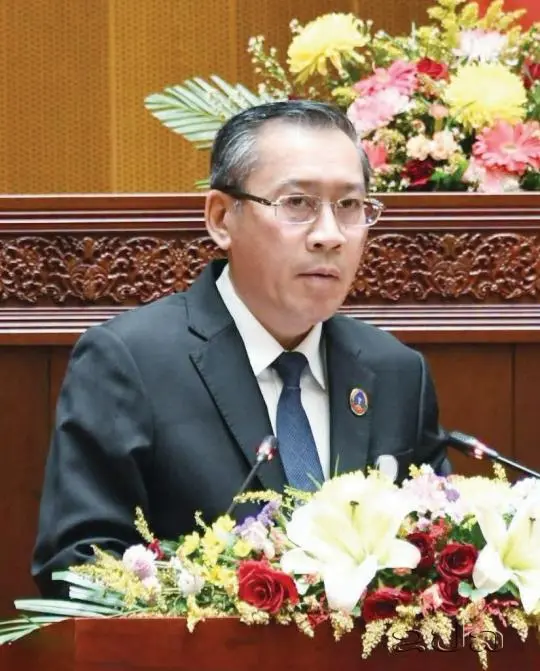
Phoxay Xayasone, Minister of Labour and Social Welfare, addressed questions from National Assembly members during the 2nd Ordinary Session of the 10th National Assembly on October 7, 2026. He discussed several key issues, notably labor skill development and job placement for Lao workers both domestically and abroad. The government and the Ministry have established mechanisms and measures to develop labor skills, secure employment, promote self-employment, rural employment, and reserve occupations that promote culture, local wisdom, low-skill or low-capital businesses, and access to funding for self-employment. These efforts aim to incentivize Lao workers to stay in the country, address labor shortages, curb the import of unskilled foreign labor, and prevent the illegal outflow of Lao workers. In the first nine months of 2026, a total of 76,604 Lao workers registered for employment assistance. This included 5,259 domestic job seekers (2,243 women) and 71,345 overseas job seekers (37,168 women). Employment was successfully secured for 119,382 individuals in total, including 57,011 women, comprising 15,772 domestic placements (5,562 women) and 103,610 overseas placements (51,449 women).
Regarding the promotion of self-employment and rural employment, the Ministry of Labour and Social Welfare has conducted pilot implementations since 2024, encouraging local workforce self-employment and entrepreneurship. This was achieved by gathering data on training needs and organizing training for targeted poor, disadvantaged, and unemployed groups interested in self-employment, particularly in the agriculture and service sectors across Oudomxay, Xiengkhouang, Xayaboury, Xaysomboun, Vientiane, Savannakhet, Champasak, Salavan, Sekong, Houaphanh, and Phongsaly provinces. Training was provided in modern agricultural cultivation techniques, mushroom cultivation and processing, cattle raising and fodder grass cultivation, handloom weaving and natural dyeing, vegetable and fruit processing, life skills, marketing, entrepreneurship, and business plan writing. In 2024, a total of 426 people (166 women) completed self-employment training, including 158 in agriculture and 264 in services. In 2025, there were 295 trainees (166 women), with 230 in agriculture, 30 in services, and 35 in transport. In 2026, 248 people (71 women) participated, including 169 in agriculture, 58 in services, and 21 in transport, with equipment provided to 175 trainees (86 women) to help them start working. Additionally, mobile agricultural vocational training was provided to 170 disadvantaged workers in remote rural areas, including 101 women. Future plans aim to promote rural employment and self-employment for a target of 750 people, while providing equipment to 323 individuals to support their self-employment.
Concerning the import of unskilled foreign labor, various parties have previously imported foreign labor both legally and illegally. The Ministry of Labour and Social Welfare issued a temporary suspension on the import and employment of foreign workers of certain nationalities to bring foreign labor management in line with Lao PDR laws and regulations. This aims to tackle illegal entry, limit labor imports for distribution, curb irresponsible neglect by importers, and prevent the use of informal brokers. All sectors must take ownership of properly managing the import and employment of foreign workers. Furthermore, local administrations are assisting in data collection and cooperating to strictly and rigorously enforce relevant laws and regulations.
News by: Thanouthong; Photos: Oaykam


More from Economy & Society
All Economy & Society Economy & SocietyLaos Announces Fuel Price Reductions Across All Types3 days ago355 views
 Economy & SocietySavannakhet Holds 2nd Ordinary Session of Provincial People’s Assembly4 days ago9 views

 Economy & SocietyOfficial Opening of the 2026 That Luang Festival in Vientiane4 days ago11 views
 Economy & SocietyFamily and MCS Mining Donate 4.5 Billion Kip for Khammouane School4 days ago11 views