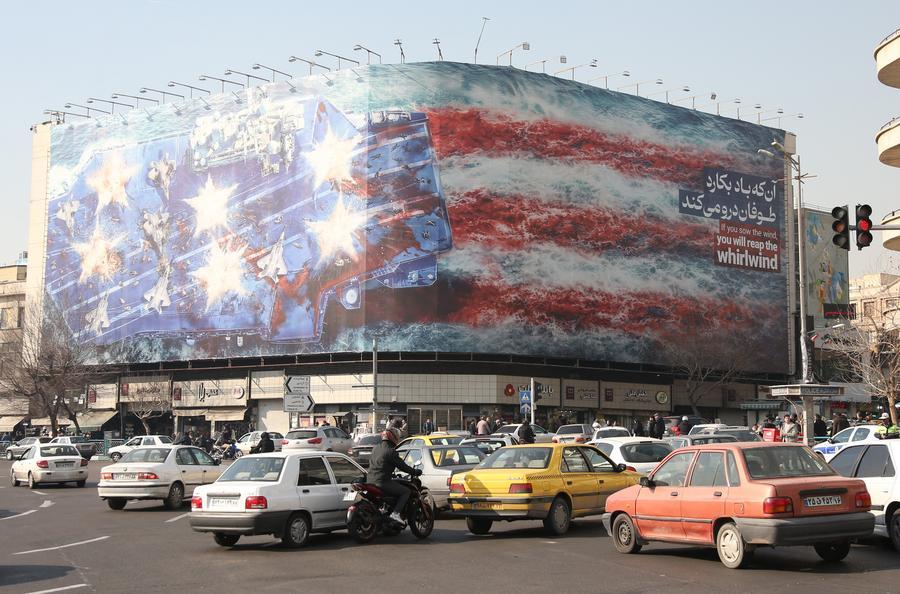


WASHINGTON/CAIRO – US President Donald Trump said on Tuesday he prefers to solve Iran confrontation through diplomacy.
“We are in negotiations with them. They want to make a deal, but we haven’t heard those secret words, ‘We will never have a nuclear weapon,'” Trump said when delivering the first State of the Union address of his second term to a joint session of Congress at the Capitol in Washington, DC.
Senior Iranian officials on Tuesday stressed Iran’s willingness to reach a nuclear deal with the United States, while Washington continues to escalate its military posture in the Middle East, deploying advanced fighter jets.
Iran’s Foreign Minister Seyed Abbas Araghchi said on Tuesday Iran is determined to reach a “fair and equitable” deal with the United States as soon as possible.
In his remarks posted on X, Araghchi said the two sides have a “historic opportunity” to strike an unprecedented agreement that addresses mutual concerns and achieves common interests, adding that a deal is within reach if diplomacy is prioritized.
His comments came ahead of a third round of indirect nuclear negotiations between Teheran and Washington, scheduled for Thursday in Geneva. Two rounds of indirect talks were held earlier this month, centered on Iran’s nuclear program and the possible lifting of US sanctions.
Also on Tuesday, Iran’s Deputy Foreign Minister for Political Affairs Majid Takht Ravanchi said Iran is ready to do “whatever necessary” to reach a nuclear agreement with the United States.
“We want to do whatever necessary to make it (an agreement) happen. We will enter the negotiating room in Geneva with all sincerity and goodwill,” Ravanchi said in an interview with NPR radio.
“We hope that our goodwill and good approach would be reciprocated by the Americans, and if there is a political will on all sides, I believe that the deal can be reached as soon as possible,” he added.
Meanwhile, during a meeting in Teheran with Armenian Defense Minister Suren Papikyan on Tuesday, Iranian Defense Minister Aziz Nasirzadeh reiterated his country’s firm resolve to defend itself.
He said Iran does not seek war, “but if a war is imposed on the country, it will defend itself strongly and give an unforgettable lesson to enemies.”
The remarks followed a drill held by Iran’s Islamic Revolution Guards Corps (IRGC) along the Iran’s southern coast, the semi-official Fars news agency reported on Tuesday.
Iranian forces practiced the scenario of “strongly defending” the country’s coasts and islands, and the IRGC Ground Forces’ special forces carrying out operations to prevent the enemy from approaching Iran’s southern coasts.
The exercise took place amid continued US military buildup in the Middle East and media reports that Trump was considering launching an initial attack on Iran.
Israel media reported Tuesday that eleven US F-22 stealth fighter jets have landed at an Israeli airbase in southern Israel, as part of Washington’s regional military reinforcement against Iran.
The world’s largest aircraft carrier, the USS Gerald R. Ford, which is en route to the Middle East, has arrived in the Mediterranean Sea. It will join the USS Abraham Lincoln carrier strike group and other guided-missile destroyers already deployed near Iran.
Trump on Monday refuted media reports that Dan Caine, the chairman of the Joint Chiefs of Staff, warned against attacking Iran.
In a social media post, Trump said that if a decision is made on conducting military operations against Iran, “it is his (Caine’s) opinion that it will be something easily won.”
Egyptian, Russian foreign ministers discuss US-Iran tensions
Egyptian Foreign Minister Badr Abdelatty held a phone call on Tuesday with his Russian counterpart Sergey Lavrov to discuss regional developments, particularly the situation in Iran.
Abdelatty emphasized the importance of de-escalation and containing the rising tensions in the region, the Egyptian Ministry of Foreign Affairs said in a statement.
He reviewed Cairo’s efforts to create an atmosphere conducive to resuming negotiations between the United States and Iran, highlighting the push toward a consensual peaceful settlement, which could spare the region from further escalation and congestion.
Iran’s Foreign Minister Seyed Abbas Araghchi said on Tuesday that Iran is determined to reach a “fair and equitable” deal with the United States, noting that the two countries “have a historic opportunity to strike an unprecedented agreement.”